2026-08-21
Proof of (Artificial) Life: Getting Nova Micro to Talk Back
Nova Reel's attempt at "a person dancing" — my coworker described it as a mixture of the stanky leg, swag surfing, and interpretive dance.
I signed up for "Getting Started with AWS Generative AI for Developers" on Coursera to get some structured practice with AWS's AI/ML stack. Pretty reasonable plan, except the console instructions in the course didn't look quite like what I was actually seeing — a quick check confirmed it: the thing is over five years old. In AI years, that's not "a bit dated," that's a different geological epoch. I then went right to the place to find the latest AWS content, courtesy of our Lead Engineer: AWS Skill Builder instead.
Nova Micro says hello
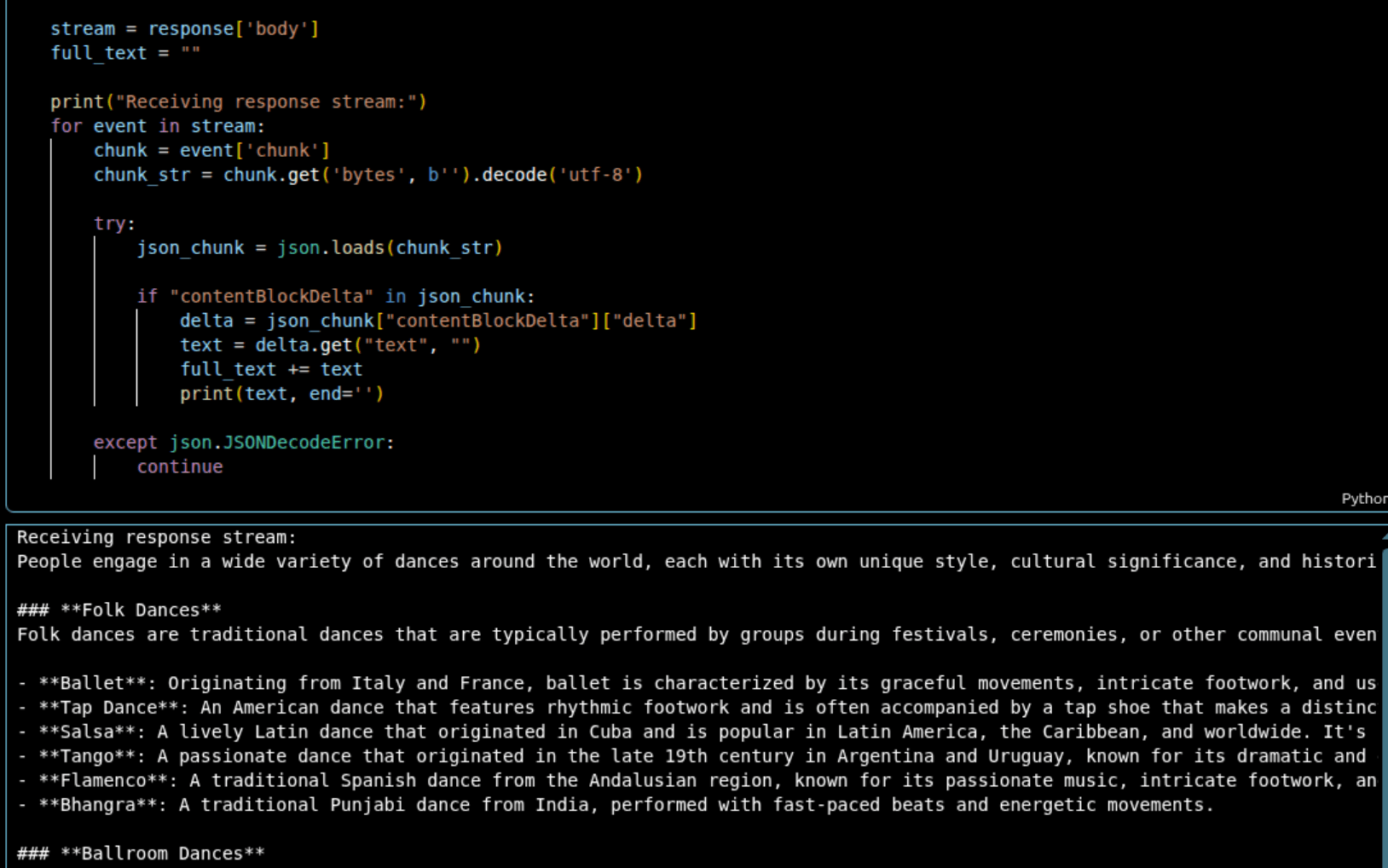
Somewhere in the middle of this, I got Amazon Bedrock to talk back for real — no slides, no
diagrams, an actual model responding to an actual prompt. I asked amazon.nova-micro-v1:0 to
describe the dances people do around the world. It did not hold back:
Receiving response stream:
People engage in a wide variety of dances around the world, each with its own unique style, cultural significance, and historical background. Here are some of the most popular and widely recognized types of dances:

### Folk Dances
Folk dances are traditional dances that are typically performed by groups during festivals, ceremonies, or other communal events. They often reflect the culture and history of a particular region.

- Ballet: Originating from Italy and France, ballet is characterized by its graceful movements, intricate footwork, and use of pointe work. It often tells a story through dance.
- Tap Dance: An American dance that features rhythmic footwork and is often accompanied by a tap shoe that makes a distinctive sound.
- Salsa: A lively Latin dance that originated in Cuba and is popular in Latin America, the Caribbean, and worldwide. It's characterized by its fast-paced, syncopated rhythms.
- Tango: A passionate dance that originated in the late 19th century in Argentina and Uruguay, known for its dramatic and emotional style.
- Flamenco: A traditional Spanish dance from the Andalusian region, known for its passionate music, intricate footwork, and expressive hand and arm movements.
- Bhangra: A traditional Punjabi dance from India, performed with fast-paced beats and energetic movements.

### Ballroom Dances
Ballroom dances are formal partner dances that are typically performed in a competitive context.

- Waltz: Perhaps the most well-known ballroom dance, characterized by its triple meter.
- Tango: Also a prominent ballroom dance known for its dramatic and sensual style.
- Foxtrot: A smooth, flowing dance with a constant rhythm.
- Cha-Cha: A Latin dance that originated in Cuba and is known for its lively tempo.
- Rumba: A passionate and sensual dance that originated in Cuba.
- Quickstep: A fast-paced dance with a lively and upbeat tempo.
- Samba: A Brazilian dance with a distinctive, rhythmic beat.

### Social Dances
Social dances are typically performed in social settings and are often less formal than ballroom dances.

- Line Dance: A group dance where participants follow a pre-determined pattern, often to country or western music.
- Swing Dance: A group of dances based on various styles of jazz music, including Lindy Hop, East Coast Swing, and West Coast Swing.
- Dancehall: A style of popular music and dance from Jamaica, characterized by fast tempo and energetic movements.
- K-Pop Dance: Dance routines choreographed to K-Pop (Korean Pop) songs, often performed by groups like BTS, BLACKPINK, and EXO.

### Contemporary Dances
Contemporary dance combines elements of several dance genres including ballet, modern dance, jazz, and others.

- Contemporary Dance: A style that focuses on free movement and often incorporates improvisation.
- Hip-Hop: A street dance style that originated in African-American and Latino communities in the United States, characterized by its rhythm, isolations, and popping.
- Breakdancing: Also known as "breaking," this style involves acrobatic and rhythmic movements, including spins, freezes, and power moves.
- Street Dance: A broad category that includes various styles that developed in urban environments, such as locking, popping, and krumping.

### Traditional Dances
These dances are rooted in specific cultural or religious traditions.

- Bharatanatyam: A classical Indian dance form that originated in Tamil Nadu, known for its expressive gestures and intricate footwork.
- Ballet Folklorico: A Mexican dance style that combines traditional folk dances from different regions of Mexico.
- Butoh: A Japanese dance-theater art form that emphasizes slow, grotesque, and abstract movements.

### Religious and Ritual Dances
Dances performed as part of religious ceremonies or cultural rituals.

- Garba and Dandiya: Traditional dance forms from the Indian state of Gujarat, performed during the festival of Navratri.
- Ritual Dances: Performed during specific religious or cultural ceremonies, such as Native American dances, Native Hawaiian hula, and African tribal dances.

These categories encompass just a fraction of the many different types of dances practiced around the world. Each dance offers a unique window into the culture and history of its origin.
Truly written like an extraterrestrial observer. The screenshot below is a straight capture of that same response:
Bonus round: Nova Reel gets creative
The video up top isn't Nova Micro's doing though; that's a separate model, Nova Reel, who I asked to generate a video of a person dancing. What came back was a figure doing something on top of a mountain that my coworker described, with more precision than I could manage: "a mixture of the stanky leg, swag surfing, and interpretive dancing." I have no notes. That's exactly what it is.
Even the "new" stuff has already gone stale
Here's the part that actually stopped me: the Skill Builder intro course I'm working through right now is less than a year old, and I still hit a lab step that was already wrong. The instructions said to select a button with one name; by the time I got there, it had been renamed "Upload," with a slightly different set of steps around it. Nothing dramatic, just enough of a mismatch to send me searching around the console for a good couple of minutes before I found it.
I am amazed at how quickly tools and practices are changing in tech; hopefully documenting my experience helps add some clarity to the noise.